Theodosia Ernest: The 19th-Century Bestseller You’ve Never Read
- 7 minutes read - 1404 wordsI spent a month of my free time transcribing an influential 1800s religious novel. And having just completed it, I can say it was so worth every minute.
Theodosia Ernest by Amos Cooper Dayton made an immense impact on American Protestants, especially Baptists. Dayton, a physician turned minister, was convinced of believer’s baptism in his 40s and thus joined a Baptist church. Soon afterward he wrote Theodosia Ernest, rumored to have been made to convince his still-Presbyterian wife (it worked, by the way).
Nearing 1,000 printed pages, it’s an immense work of both story and theology, split into two volumes.
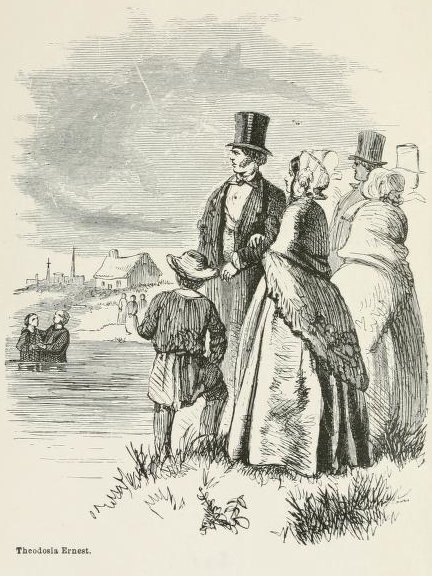
In the first, A Heroine of Faith, eighteen-year-old Theodosia is rattled when she observes a church immersing a believer at the river. She was also a believer but was sprinkled as an infant. But had she truly been baptized? For the rest of the story, Theodosia, her suitor Mr. Percy, and a few friends search for the meaning of baptism and who practices it according to the New Testament pattern. They meet the Baptist minister Mr. Courtney, who methodically guides the searchers through the Bible.
Ten Days’ Travel in Search of the Church tells of newly-married Theodosia and her husband meeting the infidel-turned-Christian Dr. Thinkwell. The doctor believes the gospel, but why are there so many churches? Surely they can’t all be right: their fundamental beliefs are often contradictory. As our company churns downriver, Mr. Courtney, Mr. Percy, our heroine, and a Methodist minister cordially compare various denominations to the Bible in search of one that follows God’s prescribed model.
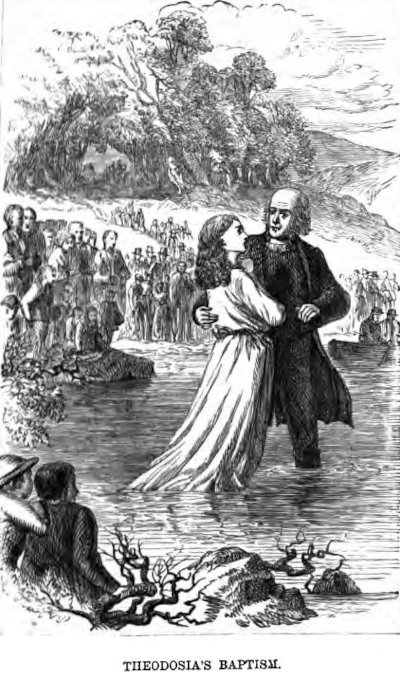
Theodosia Ernest was widely read, especially in the antebellum South. A swell of baby girls were named “Theodosia Ernest [surname]” (well over 100, according to Pastor Ben Stratton’s “Find a Grave” search); it must mean something when parents name their child after a fictional character.
Run a full-text search on Google Books or the Internet Archive, and you’ll discover a wide range of testimonies about the novel: a missionary to India who became a Baptist after reading Theodosia Ernest; a Methodist pastor who read the novel, and convinced of believer’s baptism, immersed his whole congregation and reorganized it according to the biblical model.
But not all responses were so glowing…
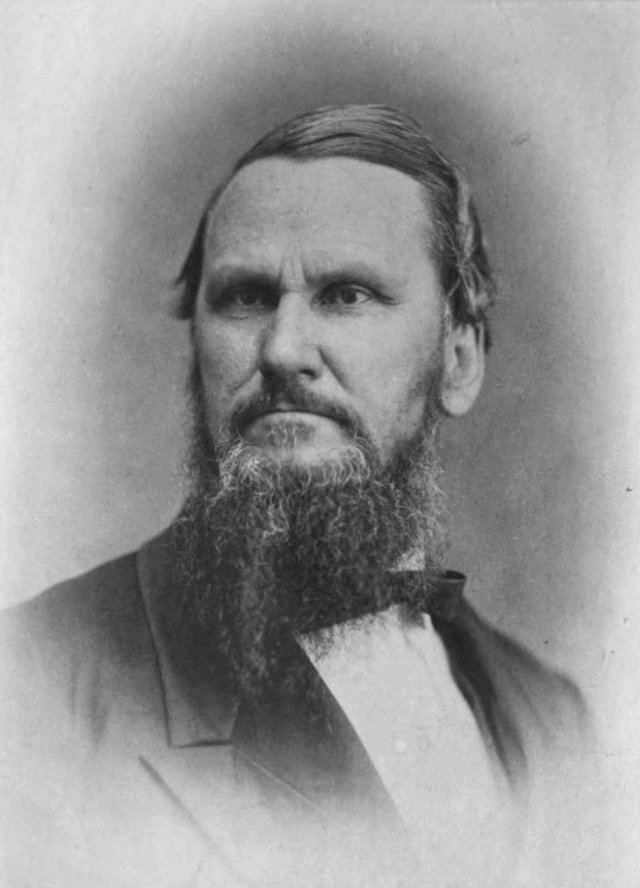
Robert Lewis Dabney
The renowned Presbyterian theologian and Stonewall Jackson biographer Robert Lewis Dabney wrote a 150-page rebuttal of Theodosia Ernest titled Fiction, No Defense of Truth. In it he lambasts author A. C. Dayton’s use of fiction to communicate such a holy subject as theology. He even compares Dayton to ”that Mother of mischief, Harriet Beecher Stowe” and her contemporaneous Uncle Tom’s Cabin.
But Annie Ketchum Dunning (also a Presbyterian) ignored Dabney’s criticism of fiction, writing two novels of her own in response to Theodosia Ernest—Theodore: A Story About Baptism and Grace Westervelt: A Child of the Covenant.
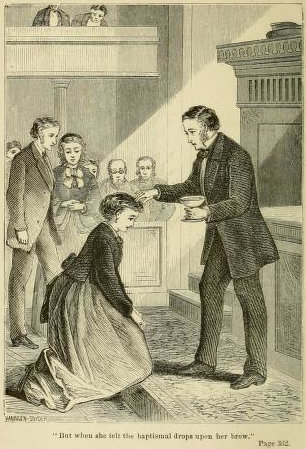
Illustration from Theodore: A Story of Baptism by Annie Ketchum Dunning
The Methodists weren’t to be left out. Theologian William P. Harrison published a 400-page novel in reply titled Theophilus Walton: The Majesty of Truth, which also defends infant baptism and sprinkling. Very few books can claim such extensive responses, but Theodosia Ernest certainly can.
I first heard about the novel late last year and figured it would be an interesting read. Theodosia Ernest has been in the public domain for decades, so I first searched Project Gutenberg. Nothing. I checked elsewhere (including a few Baptist printers) and quickly found out it just doesn’t exist. I read the first few scanned pages on the Internet Archive and was loving it. I couldn’t believe it wasn’t more widely read and known, especially among Baptists.
So I caught the ambition bug and decided I would digitize the text as I read. I had never done this, but being a software engineer and booklover, I figured I could manage it. I won’t say it was easy. In fact, it was tedious, even frustrating at times. But I plodded and plodded until I had a clean HTML reproduction of the original that was worthy of submitting to Project Gutenberg.
From the time of its original publishing in 1856 until now, there have been no full, digital transcriptions (at least not that I’m aware of), only rare antiques or scans of those old pages.
But as of January 27, 2026, Theodosia Ernest: Complete in two volumes is freely available on Project Gutenberg. Enjoy!
I would love to talk more about this! Ask me anything (via my contact form or email if you have it), and I’d be thrilled to answer.
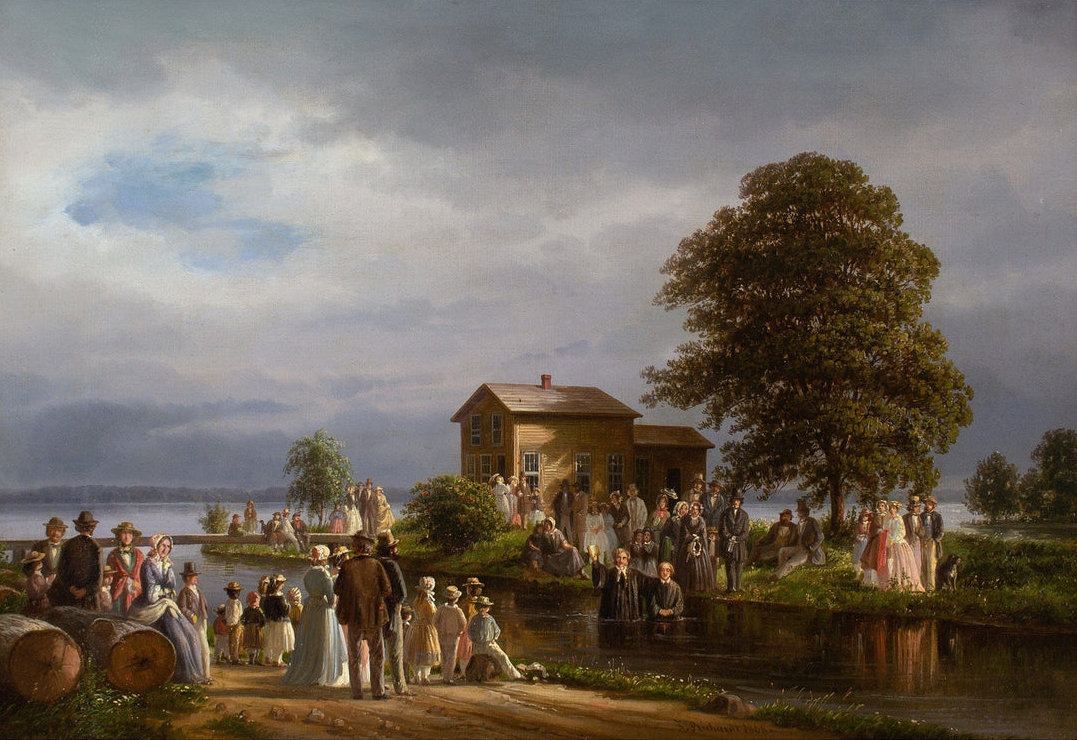
River Baptism by Joachim Ferdinand Richardt
Personal Asides
I agree with the vast majority of the arguments presented in the book, but I disagree with a few points.
A sentence or two says the King James translators erred in translating baptizo (βαπτίζω) as “baptism” instead of “immersion,” and ekklesia (ἐκκλησία) as “church” instead of “congregation.”
Though history isn’t the main subject of the book, in a brief volume 2 paragraph, Mr. Courtney argues that Albigenses were Baptist-like. I think that’s a stretch, though I do still believe Baptist-like churches existed in the 12th century—but they probably weren’t Albigenses.
The eschatology was more agreeable than I expected, though a character does state that the Catholic Church is the antichrist of Daniel and Revelation. Not the end of the world. Overall I would say the author held to a form of historic premillennialism. However, a character rightly argues that Israel and the church are distinct institutions, which of course is a key point of dispensationalism.
Then I must note this was written in the antebellum South, and there was one use of the “n-word.” Though it’s never the right word choice in 2026, it was used in an endearing way by the main character while talking to an enslaved Baptist woman (think Song of the South, 1946). Also, a character briefly conveys that era’s southern sentiment toward slavery, but it certainly wasn’t an endorsement.
Neither A. C. Dayton nor Theodosia Ernest lived in a vacuum. Dayton was a key figure in the wider Landmarkism movement of the 19th century. If you’ve never heard of the movement, you can read about it elsewhere. I’m certain many would write off A. C. Dayton because of his connections to figures like J. R. Graves and J. M. Pendleton. But after reading Mr. Dayton’s work in all its detail, I can confidently say the movement he belonged to is far from the caricatures thrown at it.
I’ve been a member of independent Baptist churches for over three decades, and Theodosia Ernest could’ve just as easily been written by one of us. In truth, anyone who attends a Baptist church could affirm volume 1 in its entirety; it’s simply a Baptist argument for the New Testament mode and subject of baptism. There would be more disagreement about volume 2, especially the chapter where local-only ecclesiology takes center stage. I understand most modern Baptists also affirm a universal church, but Dayton is fair toward that belief. The characters don’t denounce it as heresy or anything; they simply make a case for full local congregationalism. Mr. Courtney even makes a point about the necessity of mission boards and conventions, and though I disagree, it does show that Old Landmarkism was more reasonable than it’s often portrayed. It’s important to separate the 19th-century movement from unrelated fringe beliefs that came fifty or more years after, i.e. Baptist briderism and chain-link successionism.
The main characters—Theodosia, Mr. Percy, and Mr. Courtney—were very reasonable and cordial toward their theological opponents. Never was it suggested that Presbyterians, Methodists, Lutherans, Episcopalians, or Congregationalists were the enemy. Luther, Calvin, Baxter, and Wesley were described as pious men and spiritual giants, despite their errant beliefs on baptism and the church.
Whether you enjoy church history, Baptist theology, or a good religious story, I hope you’ll give Theodosia a read. I’m just happy to play a small part in keeping this conversation alive for a new generation of readers.
After all, a book that sparked multiple 400-page rebuttals and influenced hundreds of parents to name their daughters Theodosia Ernest deserves to be more than a fading book on a shelf.
Next Steps
- Update the spelling and punctuation to modern standards.
- Bring the text up to the high-quality style of Standard Ebooks and publish it there, free of charge.
- Reprint Theodosia Ernest! Anyone interested? I have a clean manuscript and would gladly volunteer my time to help typeset it.